
This is obviously not the place to continue discussion of your views. But leaving aside all the historical references, the general proof that the power set of a set cannot be put in 1-1 correspondence with members of the set--which is just a reductio--does not require "treating infinity like a number", whatever you might mean by that. The proof holds for all sets: finite and infinite, so the notion of infinity does not come into it. But given an infinite set (such as the set of natural numbers) it proves that the power set has a higher cardinality. Since both sets are infinite, it proves that some infinite sets have a higher cardinality (by the definition of what that means) than others,
How Mathematics Meets the World by Tim Maudlin
Dear Tim,
My attitude towards mathematical evidence may be similar to that by Oliver Heaviside who is nonetheless no longer my idol after I read Phipps.
So many proofs of the existence of God cannot be wrong even if they may contradict to each other. Nonetheless I will try my best and deal with Cantor 1874 and 1891 in my own thread as soon as I have the required time for that.
My own reasoning will start with the old idea that a line is a continuum every part of which has parts. In so far you could be interested too.
Leaving your thread, I would like to again highly appreciate both your refreshing attitude toward topology and your readiness to helpfully deal with my arguments even if they contradict current tenets.
Best,
Eckard
Dear Tim,
I enjoyed a lot your witty and refreshing essay. I too have mentioned the proof of Fermat's Last, but your most amusing and insightful conclusion about a companion to Wigner's paper didn't even cross my mind.
I think your treatment of time as fundamental is exciting and aiming to fill a gap in the foundations of today's physics. I know you have a book on the topic and I am planning to read it, however I am reasonably sure that the book, as any other topic-focused reading, does not answer a curiosity of mine regarding your view. I would like to know where is your intuition about time stemming from. I mean, when was that moment that your intuition crystallized and what caused it to happen? If you did write about it, I'd be grateful to be pointed to the paper in which you're describing it.
Your work is very attention-worthy and I certainly hope it receives the recognition it deserves. Should you have enough time to take a look at my essay, your comments are very welcome.
Warm regards,
Alma
Dear Alma,
Thanks for the kind words. It took a long time to arrive at these ideas, which basically come from two different directions. One was teaching the Theory of Relativity year after year, learning to think of it in purely geometrical terms rather than in terms of coordinate systems (Lorentz transformations, etc.). Eventually, one gets intuitions about how the geometrical structure works. The second strand came, while teaching on of these classes, from the realization that the standard way to approach topology is very hard to get a clear conceptual grip on. (I have had many, many students say that this is their reaction when they first learn the theory). I realized when I was trying to teach the standard approach that it does not at all correspond to how I would think of things, and asked myself whether a more visualizable theory could be created. This is the outcome of years of work in that new direction.
The curious thing is that several mathematicians have remarked how natural this way of setting things up is, and can't believe it hasn't been tried before. But so far, no one has pointed out anything similar. It is such a simple idea, in the end, that I am puzzled as well. Maybe it will turn out that someone thought of the basic approach long ago.
Once you put together a completely geometrical understanding of Relativity with this new way to think about geometry, the role on time in Relativity just jumps out at you. That was not something I was aiming at. But this mathematical language fits Relativistic space-time geometry like a glove. It is hard not to think that there is something significant in that. And time takes center stage as the basic ordering principle.
Cheers,
Tim
Tim,
As time grows short, I revisit those I have read. I find that I did not rate yours, something I usually do to those that impress me, so I am rectifying that. Hope you get a chance to look at mine.
Jim
Tim,
I only learned about you existence from watching the "time" video where you indulged the doctrine of Julian Barbour.
I knew ahead of time (no pun intended) that your philosophy would be self-consistent (no surprise there).
So this is just my "plug" to aid in judging your essay. We need people capable of composing the whole picture in an internally logical way, and Tim is one of those people. (Don't get any ideas that I agree with everything you say.). Not that you care.
En
Dear En,
I'm glad you liked the video...it was fun to do. And I never imagine anyone agrees with everything I say!
Cheers,
Tim
1. Dear Tim,
Your essay was for me the occasion to discover your theory of linear structures, and it was an enchantment. I think it won't be long till I buy your book.
Your text is particularly clear, too.
If I really like your style and your contributed linear structures, I have not really found an answer as to the effectiveness of mathematics, or, as you aptly rephrase it, how mathematics meet the world.
2. I refrained from commenting Wigner's article, because I see too many irrecoverable conceptual errors in it, for instance: ``elementary mathematics [...] entities which are directly suggested by the actual world''.
- The actual world suggests nothing.
I'd like to quote Ferán Adria, the famous Spanish chef; in answer to journalist saying that he was finding inspiration on the Costa Brava, he stood on the shore, staring at the sea and cliffs before a camera, and after a while said: ``No veo nada.'' There is nothing in clear in the landscape. Where is that inspiration?
- Wigner makes what I think is a huge mistake; implicitly, he suggests that there are things in the world that we can access in an absolute way. So, in the objects that I talk about, some are `for sure', and some are hypothetical. If you really try seriously to draw the border between the latter and the former, you come to understand that it does not exist, and that all perceptions are hypothetical. Only, some of them are usually, frequently confirmed, and we deem them solid ground. But, read Karen Blixen report of a earthquake in Out of Africa, and you will have a vivid case of a solid ground becoming moving and alive. Witness how people can be in a state of shock after a large earthquake; Haroun Tazieff used to say that their whole mental system is broken into pieces after experiencing the ``disappearance of space'', in the most concrete sense. Read Gregory Bateson's report of completely loosing ground after his experiments with sensorily puzzling effects at Adelbert Ames Jr. laboratory (in Steps to an ecology of mind). After that, read Richard Gregory's Perception as hypotheses (In The Oxford companion to the mind for instance). And read about Bach-y-Rita's experiment (guess where). You should convince yourself that the most fruitful representation is to consider uniformly all perceptions as hypotheses.
By the same token, you cannot talk about the `actual world', if you mean by that things you have a privileged, certain, absolute access to. All that you know about the world is relative to your perceptions, and is built through interaction with it, in action-perception loops: you impulse transformations into the world, and record the effects, and build pragmatically a whole world of hypotheses. You act, to abstract.
So, when you note after Wigner about the concepts of elementary geometry that ``those very concepts were developed via interaction with the world'', there is no solid way to circumscribe only them, because all your concepts, you eventually develop via interaction with the world. (You certainly agree: ``claims about [...] must be considered just as conjectural and fallible as all other physical claims.'')
(By the way, defining exactly what `elementary geometry' should be is not trivial, and finally not univocal because it poses a problem of foundation, and what we think is the historical, or natural genetic approach is not obviously better. Shall we just say that rays of light are our concept of a straight line? Shall we say that sets and groups are at the root? Shall we say that topos is a more elementary foundation?)
3. In the words of a common metaphor, Wigner sins by confusing the map for the territory.
(Korzybski for instance has repeated much this dictum.)
All what we do in our theories is language, and the world is not language.
The trains of spikes in your neuron chains are not labelled `vision', 'touch', `warmth', etc. These concepts are built afterwards. They do not exist substantially in the world, ready to be channeled to your perception. If you excite the retina by an electrical impulse, the subject reports a flash of light --the usual hypothesis for what comes from the retina. The most striking demonstration is in Bach-y-Rita experiment (refer to my essay for a pointer).
These facts should make clear that all we operate on is within the `maps' world. All we build in our maps is hypothetical constructs, that we try to fit to the interactions we engage with the territory that we know is out there.
So to be accurate, we must always maintain that we talk indirectly about the territory, through a representation. Any statement made directly about the territory, the world is problematic because it cancels this relativity to the representations of the subject. A statement about the territory itself, being absolute, must be completely right. Therefore, it cannot be scientific. It fails to satisfy Popper's criterion. If a statement fits Popper's criterion, then it is hypothetical.
It has nearly always been that progress has occurred when the operation of representation was made explicit and stated clearly. For instance, a correct definition of what a measure is, in mathematics, could not be derived until after there was a clear separation between the measurement, and the scale used to represent measurement, that is, a usable theory for the real numbers. I took an even simpler example in my essay, with the confusion between numbers-of something, and numbers `pure', and how until the late 19th century (!) not being able to separate clearly numbers from what they could be used for --counting objects or representing quantities in this case-- was impeding comprehension and progress in using them.
The conclusion is that to be able to address properly the question of the effectiveness of mathematics in representing the world, we have to include the stage of representation of the world in our framework. That is, we have to include the stage of perception and cognition in our representation, and that means including explicitly the cognitive subject.
4. I have the feeling that you have fallen in the same trap as Wigner, when you write:
``claims about the geometrical structure of physical space or space-time must be considered just as conjectural and fallible as all other physical claims.''
``A proper answer to this question must approach it from both directions: the direction of the mathematical language and the direction of the structure of the physical world being represented.''
In both cases, if I am not misinterpreting, by `physical space' and `physical world', you are not talking about the space or the world, as seen by physics, but about the world itself. You have no final word about the structure of the world. You have all latitude to propose hypothetical physical structures that prove fruitful for various uses.
5. Your title is particularly accurate and promising, because the key issue is exactly the meeting of mathematics and the world. I completely agree with it, and it is precisely what I have just said above: the issue is on perception. Perception is fundamentally a meeting, at any considered scale: Subject and event, sensory organ and object, sensory neuron and stimulus, etc.
If you think you talk about perception, and see no meeting, then you are certainly talking about things that take place during perception, but not the fact of perception itself, properly regarded.
Regards
Dear Vincent,
Thanks for the extensive comments.
You seem to object to the idea of some immediate, certain access to the structure of the physical world via perception. Of course that is correct. I'm sure I have not written anything that suggests otherwise. Physical theories are always conjectural.
But it is also clear that some mathematical structures (say Euclidean geometry) were suggested fairly directly by interaction with the world and perception, while others (octonians) were arrived at by abstract considerations fairly far removed from perception. This observation is compatible with the fallibility of perception, perceptual error, etc.
Yes, by "physical space" or "physical space-time" I mean what we wave our arms and legs around in! Physical theories are proposals for the structure of that, and its contents. The aim of physical theory is to give an accurate account of physical space (or space-time) and its contents. What we can alter are the theories, not the object that the theories are designed to describe. And of course no one has "the final word" about whether a physical theory is an accurate description of the physical world. That is the point of being fallibilistic about all theories.
Cheers,
Tim
Tim Maudlin Apr. 4, 2015: "Put two high-precision atomic clocks on the floor together Synchronize. Lift one up on a table. Wait a while. Return to the floor and compare synchronization. This has been done. The clocks go out of syntonization, and the amount out is a function of how long the one is up on the table. No redshift or light involved. Experiments at this precision have only been possible recently."
You abandoned this discussion after realizing that no such experiment has ever been done (no lifting and then returning to the floor). Gravitational time dilation has always been measured by measuring the gravitational redshift but the redshift actually confirms the variable speed of light predicted by Newton's emission theory of light:
Albert Einstein Institute: "One of the three classical tests for general relativity is the gravitational redshift of light or other forms of electromagnetic radiation. However, in contrast to the other two tests - the gravitational deflection of light and the relativistic perihelion shift -, you do not need general relativity to derive the correct prediction for the gravitational redshift. A combination of Newtonian gravity, a particle theory of light, and the weak equivalence principle (gravitating mass equals inertial mass) suffices. (...) The gravitational redshift was first measured on earth in 1960-65 by Pound, Rebka, and Snider at Harvard University..."
Pentcho Valev
I stopped the discussion because you do not know the situation with respect to either the predictions or tests of General Relativity. The basic scheme of actually comparing clocks has been going on for over three decades. These are not gravitational redshifts. Everyone knows the gravitational redshift is a weak test, but the tests moving and comparing clock readings are just different. Your insistence that they are not just demonstrates your mack of understanding of the situation.
"The basic scheme of actually comparing clocks has been going on for over three decades. These are not gravitational redshifts. Everyone knows the gravitational redshift is a weak test, but the tests moving and comparing clock readings are just different."
Such tests do not and cannot exist. As I have already said, these clocks are atomic oscillators that do not keep record of the time elapsed. So there is no point in lifting one of them and then bringing them together - there is nothing to compare. One can only measure the frequency difference (redshift) and ponder whether it is due to gravitational time dilation or variation of the speed of light with the gravitational potential.
Of course nobody is going to check which of us is telling the truth - you are right by definition. So... good luck!
Pentcho Valev
1971
http://en.wikipedia.org/wiki/Hafele-Keating_experiment
Such tests have exited for 44 years.
That is a fact.
If you think they "do not an cannot exists" then you have been proven wrong.
Initially you wrongly referred to this experiment:
http://www.nist.gov/public_affairs/releases/aluminum-atomic-
clock_092310.cfm
as an example of lifting one of the clocks and then bringing the two clocks together in order to compare them. Then you took refuge in the GPS system, and now you want to discuss the Hafele-Keating experiment which was not meant for measuring gravitational time dilation. Let us stop here.
Pentcho Valev
Dear Tim,
Thank you for your answer as it's a very interesting insight regarding how new theories come to be. I don't find it particularly odd that no one thought of your idea before, because most people don't feel the need to innovate as long as there exists a functional theory, all the more since the effort of creating a logically sound new approach is considerable. Also I'm sure your unique intuition has to do with this, because I think I understand that your approach allows for discreetness, not necessarily requiring infinitesimals.
Cheers,
Alma
Dear Tim Maudlin,
I will comment mainly on the first part of your essay. (The second part of the essay, in which you outline your new foundations for geometry, is interesting in it's own right, but it does not seem to address the original question as directly.)
One aspect that I liked is that you distinguish the surprise due to discovering a connection between seemingly distinct parts of mathematics from the wide applicability of mathematics to empirical sciences.
In the first part, you also think about how the world needs to be in order for the counting numbers to be relevant. You give mountains and cells as examples of concepts that are not (always) sharp enough (conceptually) for counting, and atoms as an example of a concept that is. In my view, however, the sharpness of our concepts is a matter of degree. The concept of an 'atom' is still a vague one, to some degree; hence the question of whether something is an atom or not -and whether to count something as an atom or not- may still be ambiguous in certain situations. For instance, one can imagine an electron and a proton: they will always 'feel' each other's electrical field. When, exactly, do they form a hydrogen atom? This question is also relevant in foundations of chemistry (with competing partition schemes in computational chemistry to identify 'atoms in molecules').
Viewed in this way, there are many degrees of freedom in applying mathematics to empirical findings - something which is rarely discussed in relation to the perceived effectiveness of mathematics.
Best wishes,
Sylvia Wenmackers - Essay Children of the Cosmos
Dear Sylvia Wenmackers,
Thanks for the comment. I do completely agree with what you say, which is why also the term "atom" is not used in the formation of fundamental physical law. First it was replaced by reference to electrons, protons and neutrons and then by reference to electrons and quarks. Since atoms are bound states of these things, the concept is only as sharp as "bound state", which is somewhat vague. At this point, "electron" and "quark" appear to be fundamental, and admit of not further analysis. But we may be wrong about that.
Cheers,
Tim
Dear Tim, I very much enjoyed your essay and hope you can clarify one point for me. It seems that your argument suggests that there may be equivalent frameworks for describing physical systems (such as topology or linear structures) but that only one corresponds to physical reality. This suggests that we could be using the wrong mathematics to describe reality purely because distant branches of mathematics that seem unrelated are actually deeply related. How would we ever know then that we had the "right theory"?
Dear Tim :
Your essay is very interesting,
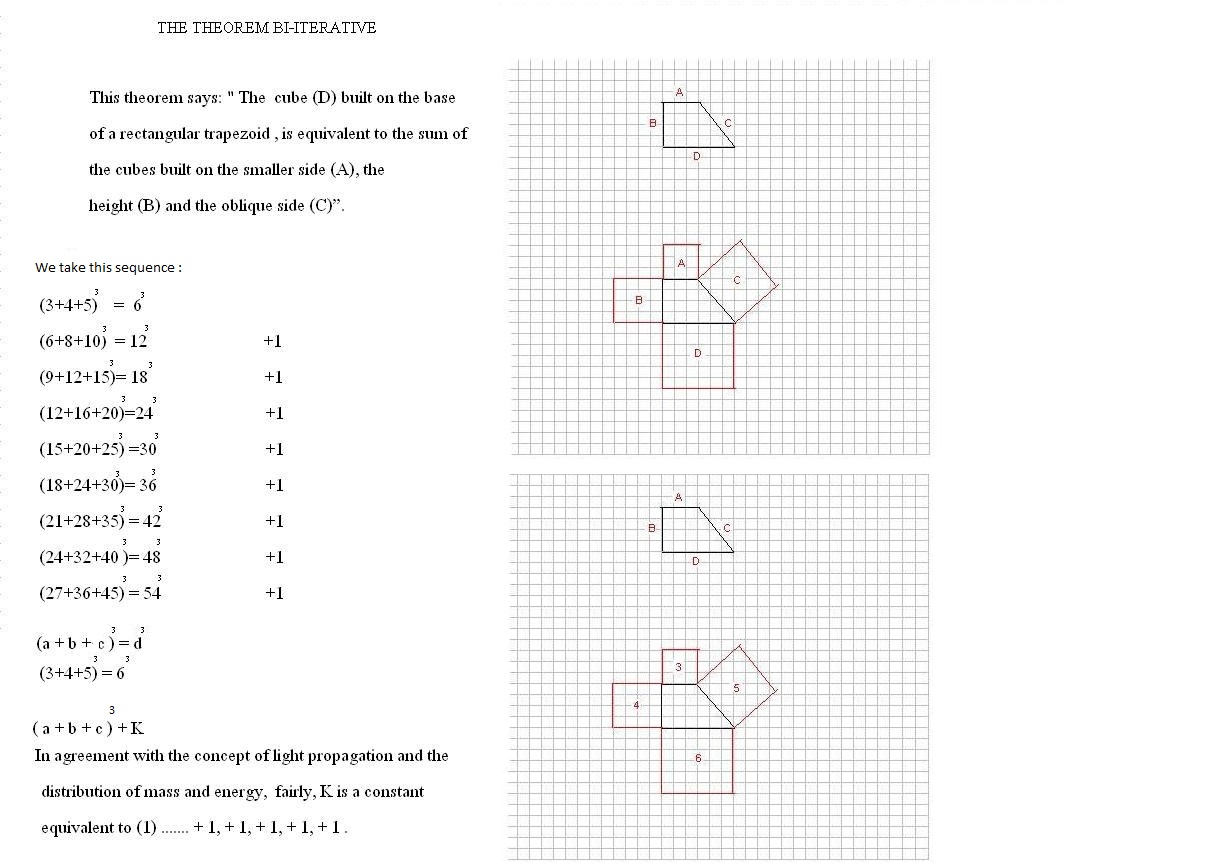
In my opinion, mathematics that reflects reality, remains a priority for the current science.The Bi-iterative calculation could be the right one, because it has all the characteristics of a pure mathematics.
"NUMBERS"
first are integers
second are geometric shapes
third are physical entities, with infinite degrees of freedom
fourth maintain always the aspect ratio
fifth are elastic ... ..
Sixth are compact, and unseverable by two egual part.
We take an example:
1 + 5 + 7 + 12 =
= 1 + 5 + 7 + (6 + 8 + 10)
= 1 + 5 + 7 + (3 + 4 + 5) + 8 +10)
= 1 + 5 + 7 + (3 +4 +5) + (1 + 6 - 9) + 10
= 1 + 5 + 7 + (3 +4 +5) + (1 + 6 - 9) + 10
= 1 + 5 + 7 + (3 +4 +5) + (1 + (3 + 4 + 5) - 9) + 10
= 13
=2197
Of course, we speek about a cubic equazion.
Recursive calculation, the Fibonacci series and Fractal are wrongly linear, because they consider the space as a bi-dimensional sheet.
The system's Bi-iterative calculation is different, it consider the space, multi-directional and multi-dimensional. In fact, exist only set and sub-set. with (1) we mean (1 * 1 * 1).
Because we live in a complex and varied reality, only a struture able to transform can describe it.
The human brain is divided into two halves, the left hemisphere is masculine, active, called "rational". The right hemisphere is feminine, passive called "irrational".
The most important thing is that these two opposing positions should coexist. (x + 1) and (x - 1) are two limits , i meam the linear structure and the non-linear structure are inseparable.
A system that can not stop,follow the arrow of time. Or rather, it coping itself, reflecting itself. So, we have (x + 1), + 1, + 1, + 1 ....
"The universe was born like that, one bit after another, and continues to do so even now".
(See ANNEX)"The teorem"
sincerly yours
BannouriAttachment #1: 1_1_Theorem_1.jpgAttachment #2: 1_1_Theorem_345.jpg

Dear Sara,
I don't think we will ever we absolutely sure we have the right theory. All we can do is formulate different theories, using different mathematical resources, see what sorts of testable, observable behavior they predict, and try to gather data to test them. But there will always be different theories that agree with all the data we have. Choice among these different theories that are consistent with observations will either be made on grounds of simplicity, elegance, etc. or else not be made at all: we will just have to admit that we don't know for sure which, if any, if these theories is correct. But whatever we do, we have to acknowledge that we cannot be certain that any particular theory is right. That's just the situation we are in.
Cheers,
Tim